Interval Billing

Helping you understand the changes to your bill

Hydro One, like other utilities in Ontario, is transitioning all of its large customers who have an average monthly peak demand of over 50 kW to interval billing as directed by the Ontario Energy Board (OEB).

In support of this transition to interval billing, we have upgraded our metering, billing systems and monitoring tools to empower customers to manage and control the energy use and costs at their facilities.
 

What is interval metering and billing?

Interval metering allows you to monitor your energy consumption by tracking your hourly usage. As you now have an interval meter installed at your facility, we are able to collect your usage across all units of measurement (kWh, kW, kVA), in hourly time intervals. The interval usage data collected through remote communications is used for billing purposes.
 

Why is my account moving to interval billing?

We are transitioning all our larger customers who have an average monthly peak demand of 50 kW or more to interval billing as directed by the OEB.

Benefits of interval billing

icon of electricity use  
Greater control over electricity usage

Most customers will now have the ability to manage the electricity portion of their bill by shifting the usage at their facilities and save money without needing to reduce their overall energy usage.

icon of a gear  
Greater control over delivery

Customers will have access to view and download the hourly usage for their facilities to see when the peak demand occurs and find ways to reduce it.

How will interval billing change my bill?

See the sample bills below to compare your old bill format to your new bill format.
 

Old bill: Billing based on INDEX reading

Old bill sample: Non-Interval  

New bill: Billing based on (hourly) INTERVALS

New bill sample: Interval billing  

Frequently Asked Questions

How will my bill change?

What are the electricity pricing options available?

How might my electricity pricing change?

For customers who are currently billed on Regulated Price Plan tiered pricing, the table below shows your electricity pricing options. Customers must use less than 250,000 kWh a year to be eligible for Regulated Price Plan pricing.
 

Customer choice is here. Your business now has the option to switch to tiered prices. Tiered prices allows your business to use a certain amount of electricity each month at a lower price. Once that threshold is exceeded, a higher price applies. To see if your business would benefit from switching, visit HydroOne.com/CustomerChoice.

Old Electricity Pricing Option New Electricity Pricing Option – Default New Electricity Pricing Option – Opt In New Electricity Pricing Option – Retail Contract

Regulated Price Plan Tiered Pricing

Regulated Price Plan Time-of-Use (TOU) Pricing

Hourly Ontario Electricity Price (HOEP) + Global Adjustment (GA)

Contract with an electricity retailer + Global Adjustment (GA)

Based on two tiers:
 
9.3¢ for up to 750 kWh a month
11.0¢ above 750 kWh a month

Based on three periods:
 
15.8¢ for on-peak
12.2¢ for mid-peak
7.6¢ for off-peak

Wholesale Electricity Price changes on an hourly basis depending on demand and the availability of supply (¢/kWh).
 
It is based on your actual hourly use.
 
GA is set on a monthly basis by the IESO ($/kWh)

Based on the retailers contract price.
 
GA is set on a monthly basis by the IESO ($/kWh)


For customers who are currently billed on the weighted average hourly spot price, the table below shows your electricity pricing options.
 

Old Electricity Pricing Option New Electricity Pricing Option – Default New Electricity Pricing Option - Retail Contract

Weighted Average Hourly Spot Price (WAHSP) + Global Adjustment (GA)

Wholesale Electricity Price + Global Adjustment (GA)

Contract with an electricity retailer + Global Adjustment (GA)

WAHSP is the average spot market price, weighted by the usage patterns of all of Hydro One’s non-interval metered consumers. It uses Net System Load Shape (NSLS), which is the aggregate consumption of all of the electricity consumers in a utility who do not have interval meters. Your monthly consumption is multiplied by the percentage for an hour, and then multiplied by the price for electricity for that hour.

Wholesale Electricity Price changes on an hourly basis depending on demand and the availability of supply (¢/kWh). It is based on your actual hourly use.

Based on the retailers contract price

GA is set on a monthly basis by the IESO ($/kWh)

GA is set on a monthly basis by the IESO ($/kWh)

GA is set on a monthly basis by the IESO ($/kWh)


Customers who are billed by an electricity retailer will not see any change to how they are billed for electricity. The only change will be to the delivery component of the bill.

If you are unsure on how you are currently billed for electricity, please see page two of your bill or call us.
 

What are the Time-of-Use (TOU) prices?

How do I opt out of Time-of-Use prices?

What is the Wholesale Electricity Price?

How will the billing of the Delivery charge change?

Delivery is a combination of fixed and volumetric charges. The volumetric components are billed using your peak demand, which is the highest electrical power demand that occurs over a billing period. Previously, this was measured using a 15-minute register read and now this will be captured at the hourly interval.
 

For most customers, the impact of this change is likely to result in a modest reduction in delivery charges, as your peak use must now be sustained for a longer period before it registers as a peak.
 

Please note the Network Service Rate is another variable component of your delivery charge. It is billed on your peak demand on business days from 7 a.m. to 7 p.m.
 

graph from the IESO showing how to determine your peak demand

Source: IESO


What services are available?

How can I access my interval metering data?

What are the electricity pricing options available?

For businesses with an average monthly peak demand of 50 kW or more that use less than 250,000 kWh a year, there are three pricing options available for electricity:

  1. Time-of-use prices (TOU) – default option.

  2. Hourly Ontario Electricity Price (HOEP) – this is the wholesale market rate that changes every hour. You will need to opt in.

  3. Retailer contract – It is important to note that if you are billed HOEP or sign a retail contract you will also be billed the global adjustment (GA) rate as a separate line item on your bill. GA rate is built into TOU prices, so you will not see it as a separate line item on your bill.

 
For businesses with an average monthly peak demand of 50 kW or more that use more than 250,000 kWh a year, there are two pricing options available for electricity:

  1. Hourly Ontario Electricity Price

  2. Retailer contract.

With both these pricing options, you will be billed GA rate as a separate line item on your bill.

 
If you have an average monthly peak demand of 50 kW, we will send you a letter to let you know which pricing options are available to you.

Your electricity bill explained


How might my electricity pricing change?

For customers who are currently billed on Regulated Price Plan tiered pricing, the table below shows your electricity pricing options. Customers must use less than 250,000 kWh a year to be eligible for Regulated Price Plan pricing.
 

Old Electricity Pricing Option New Electricity Pricing Option – Default New Electricity Pricing Option – Opt In New Electricity Pricing Option – Retail Contract

Regulated Price Plan Tiered Pricing

Regulated Price Plan Time-of-Use (TOU) Pricing

Hourly Ontario Electricity Price (HOEP) + Global Adjustment (GA)

Contract with an electricity retailer + Global Adjustment (GA)

Based on two tiers:
 
11.9¢ for up to 750 kWh a month
13.9¢ above 750 kWh a month

Based on three periods:
 
12.8¢ for on-peak
12.8¢ for mid-peak
12.8¢ for off-peak

HOEP changes on an hourly basis depending on demand and the availability of supply (¢/kWh).
 
It is based on your actual hourly use.
 
GA is set on a monthly basis by the IESO ($/kWh)

Based on the retailers contract price.
 
GA is set on a monthly basis by the IESO ($/kWh)


For customers who are currently billed on the weighted average hourly spot price, the table below shows your electricity pricing options.
 

Old Electricity Pricing Option New Electricity Pricing Option – Default New Electricity Pricing Option - Retail Contract

Weighted Average Hourly Spot Price (WAHSP) + Global Adjustment (GA)

Hourly Ontario Electricity Price (HOEP) + Global Adjustment (GA)

Contract with an electricity retailer + Global Adjustment (GA)

WAHSP is the average spot market price, weighted by the usage patterns of all of Hydro One’s non-interval metered consumers. It uses Net System Load Shape (NSLS), which is the aggregate consumption of all of the electricity consumers in a utility who do not have interval meters. Your monthly consumption is multiplied by the percentage for an hour, and then multiplied by the price for electricity for that hour.

HOEP changes on an hourly basis depending on demand and the availability of supply (¢/kWh). It is based on your actual hourly use.

Based on the retailers contract price

GA is set on a monthly basis by the IESO ($/kWh)

GA is set on a monthly basis by the IESO ($/kWh)

GA is set on a monthly basis by the IESO ($/kWh)


Customers who are billed by an electricity retailer will not see any change to how they are billed for electricity. The only change will be to the delivery component of the bill.

If you are unsure on how you are currently billed for electricity, please see page two of your bill or call us.
 

What are the Time-of-Use (TOU) prices?

The OEB sets TOU prices that differ depending on when you use electricity. There are three demand periods:

  • On-peak, when demand is highest. These are the busiest times of day – generally when people are cooking, starting up their computers and running heaters or air conditioner

  • Mid-peak, when demand for electricity is moderate. These periods are during the daytime, but not the busiest times of day

  • Off-peak, when demand for electricity is lowest.
     

As of June 1,2020, due to the COVID-19 pandemic, The Ontario Government has Set a Fixed electricity price of 12.8¢/kWh, 24 hours a day, seven days a week until October 31, 2020.
Illustration of the Summer 2020 TOU demand and pricing periods  

Summer Weekdays

Summer weekday periods are effective May 1 to October 31 each year. Effective March 24, 2020, the winter periods will remain in effect until further notice.

Illustration of the weekend and holiday TOU demand periods and pricing (off-peak)  

Weekends & Holidays

Weekends and designated holidays are off-peak electricity prices all day.

Illustration of the TOU demand periods and prices for summer off-peak as of June 1, 2020: 12.8 cents/kWh for all demand periods  

Time-of-Use Prices

Prices shown are effective June 1, 2020 to October 31, 2020. 

To learn more about how your facility could benefit from these prices, please visit www.oeb.ca.
 

How do I opt out of Time-of-Use prices?

If you would like to opt out of TOU prices, please give us a call at 1-866-922-2466 or send us an email at BCC@HydroOne.com and one of our advisors would be happy to help you. Our office hours are Monday to Friday, 8:30 a.m. to 5 p.m.
 

What is the Hourly Ontario Energy Price?

The Hourly Ontario Energy Price (HOEP) is determined through the wholesale electricity market, which is managed by the Independent Electricity System Operator (IESO). HOEP changes on an hourly basis depending on demand and the availability of supply. Factors affecting demand include consumer behavior, weather, time of day, day of week as well as economic conditions.
 
HOEP is only one part of the total cost for electricity. Businesses also pay the Global Adjustment (GA) rate. We will bill you for both items without any markup.
 
The table below shows the average weighted hourly price the current year and previous years.
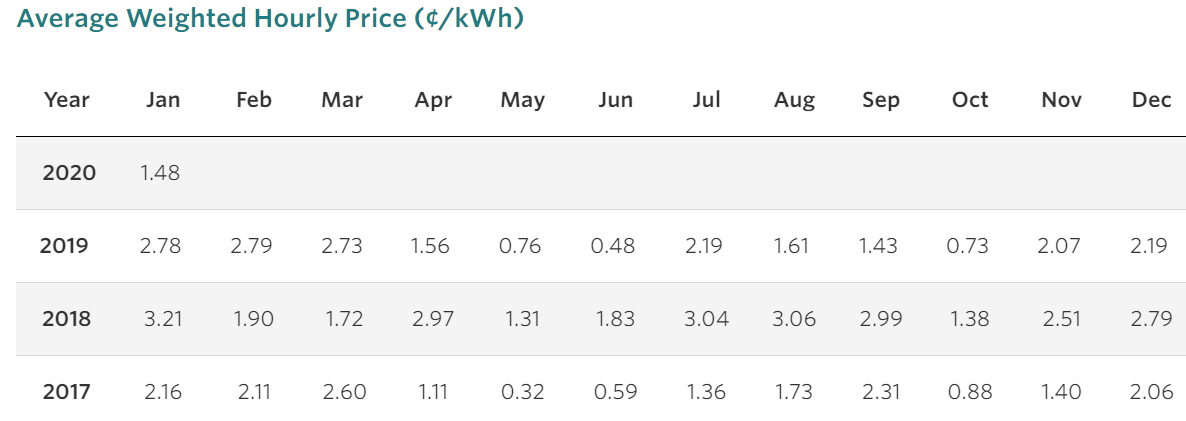
 

table of average weighted hourly price  

Source: IESO


The graph below shows the inverse effect of HOEP and GA. Generally, when GA is higher, HOEP is lower and vice versa.
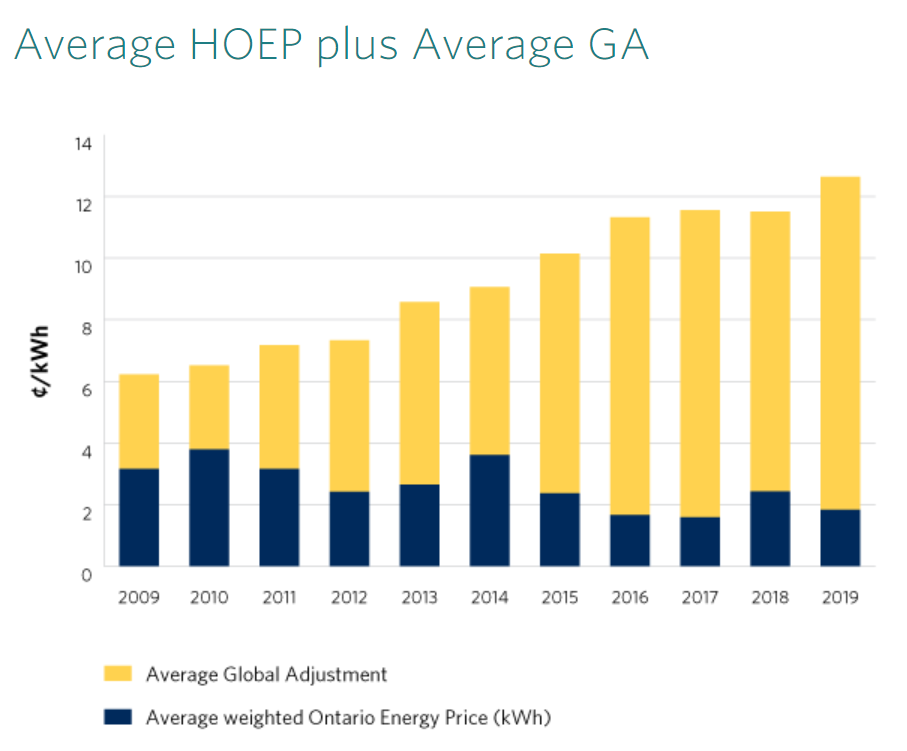
 

graph of average HOEP plus Global Adjustment  

Source: IESO


To learn more about HOEP and GA, please visit www.ieso.ca.
 

We can help you decide which electricity pricing option is best for your business by doing an in-depth review for you.


How will the billing of the Delivery charge change?

Delivery is a combination of fixed and volumetric charges. The volumetric components are billed using your peak demand, which is the highest electrical power demand that occurs over a billing period. Previously, this was measured using a 15-minute register read and now this will be captured at the hourly interval.
 

For most customers, the impact of this change is likely to result in a modest reduction in delivery charges, as your peak use must now be sustained for a longer period before it registers as a peak.
 

Please note the Network Service Rate is another variable component of your delivery charge. It is billed on your peak demand on business days from 7 a.m. to 7 p.m.
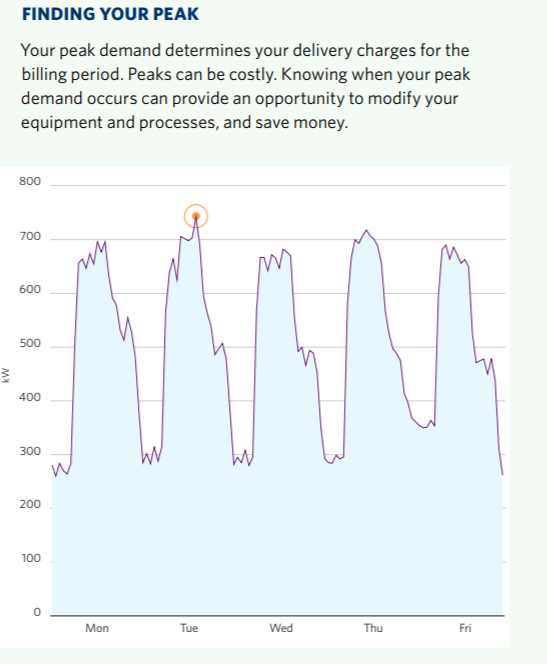
 

graph from the IESO showing how to determine your peak demand  

Source: IESO


Why is the billing date changing?

Most customers will see a change in the date when they receive their bill. We are changing billing dates so we can make some operational improvements in order to serve you better.
 

Customers who are transitioning to interval billing will receive a letter from us, which will show their new billing date. If you would prefer a different billing date, please give us a call as we have some flexibility and would like to work with you to make this change easier for you.
 

If you are interested in seeing the date when your usage ends and when you will receive your next bill, please click here. You will need to check page one of your bill to find your Bill Group.
 

Sample of an old bill

sample of an old Hydro One bill
Sample of a new bill
 
sample of a new Hydro One bill

What new services are available?


icon of a computer screen with a graph on it  

Access to a new online data portal to view and download your hourly energy usage, as well as analysis and reporting tools. These insights can support a more effective energy management program for your facilities.

icon of an electronic bill  

A new data delivery service allowing you to choose to have metering data and forecast billing information emailed to you each month.

icon of a call agent  

A dedicated team of skilled advisors who will be happy to answer your questions when you call us at 1-866-922-2466 or email us at BCC@HydroOne.com. Our office hours are Monday to Friday, from 8:30 a.m. to 5 p.m.
 

How can I access my interval metering data?

Eligible customers can access their interval metering data through our new online data portal where you can view and download your hourly energy usage across multiple meters and accounts. Analysis and reporting tools can help support a more effective energy management program for your business.